

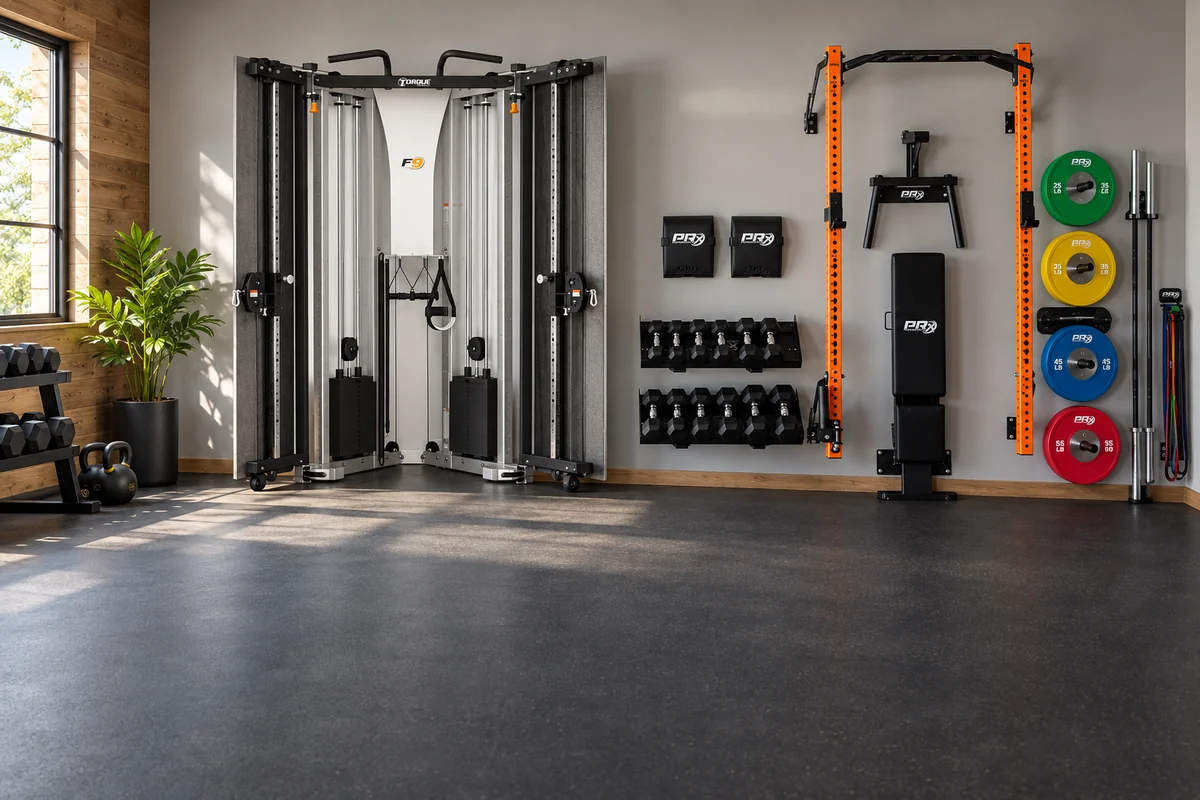
How to Choose Folding Gym Equipment for Your Home
Pick the folding mechanism that fits your training, then verify the open floor space, installation, accessories, and daily setup.
The appeal of folding gym equipment is simple: train in a room that can serve another purpose afterward. The buying decision is less simple. A rack can fold against a wall while the barbell, plates, and bench still need storage. A cable machine can close behind doors yet continue to occupy floor space. And a lightweight bench might fold in seconds but offer fewer exercise positions than the bench you actually need. This guide walks you from room measurements to a workable full-body setup.
Start With the Workout You Want to Repeat
Before comparing product photos, write down the lifts you want to perform twice a week, who will use the room, and how fast the space must return to its other use. Browse folding gym equipment by movement and storage method. If your program needs barbell squats and pull-ups, a folding bench alone cannot solve it. If you want adjustable cable resistance and minimal gear on the floor, a basic wall rack is only the start of the purchase.
Shared living space
Prioritize a quiet setup, rapid put-away, clear walking paths, and a home for attachments. Check whether the stored machine actually clears the floor.
Garage strength station
Prioritize safe mounting, barbell clearance, stored plate locations, and whether a car or door still fits when the rack is folded.
Cable-based training
Prioritize pulley positions, load per handle, cable travel, and how easily both sides of the machine can be used.
Mixed training
Prioritize a setup that accommodates a bench and basic free weights without turning every session into a lengthy assembly project.
1. Measure Three Footprints, Not One
Manufacturers often highlight the smallest dimension: folded depth. That number cannot tell you whether you can squat, extend a cable, load a bar, or swing a door. Measure stored size, open machine size, and full workout zone separately. Add the space you need for your own stance, bench movement, cable travel, safe entry and exit, and equipment storage. Check ceiling height at the actual installation wall, not just in the middle of the room.
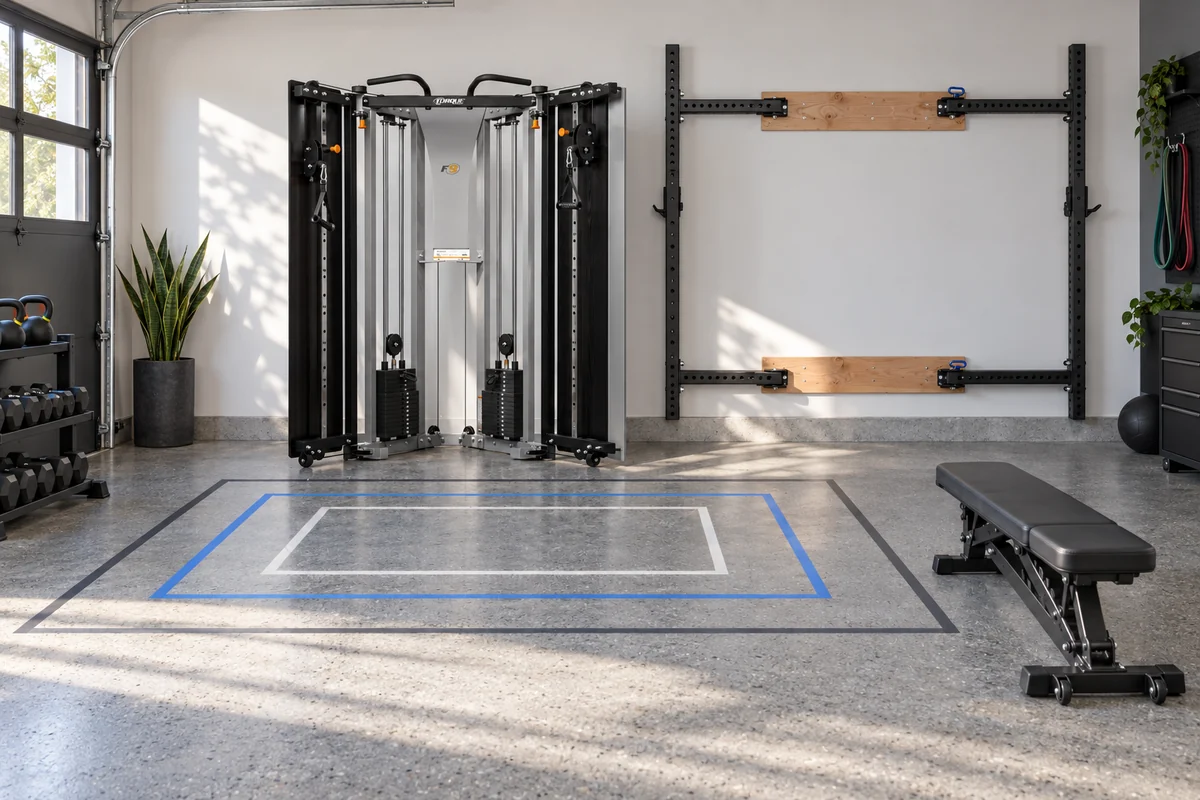
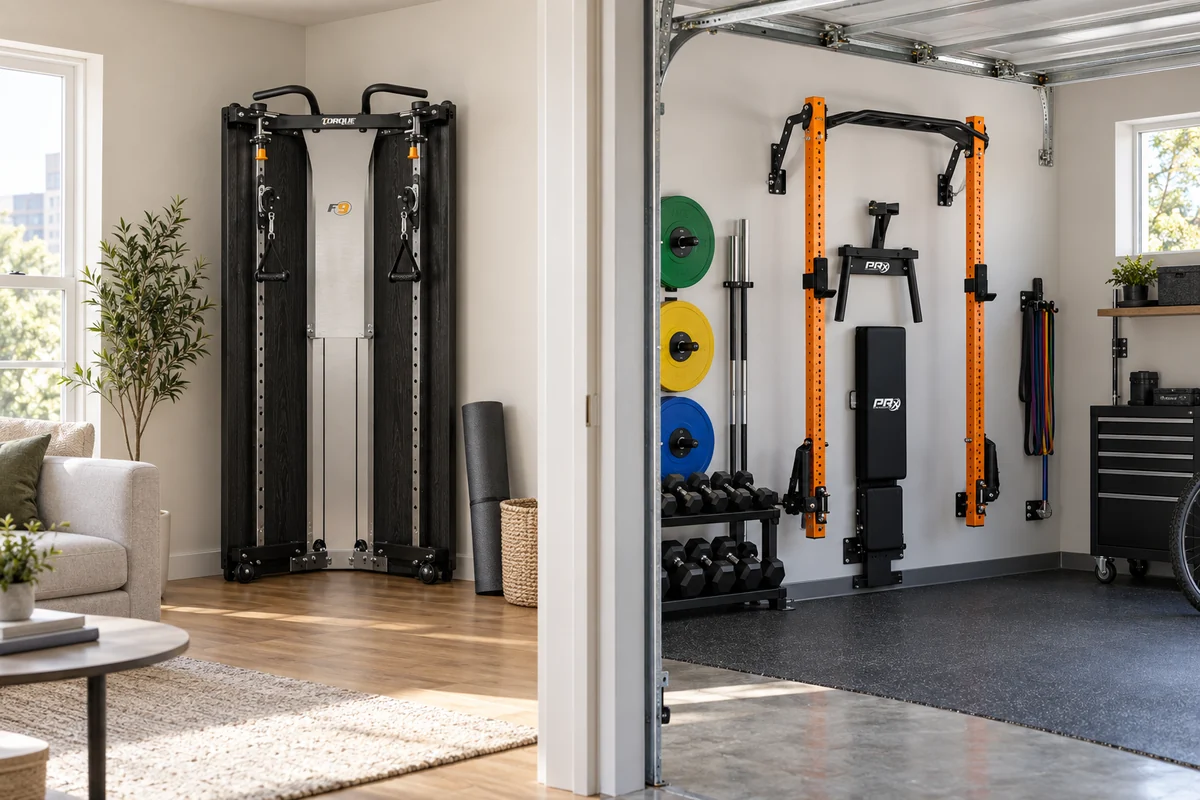
For a real-world example, Torque lists the Free-Standing F9 at 34.9 × 44.6 × 83.8 inches with its doors closed and 61.2 × 69.7 × 83.8 inches with them open. The doors fold away, but the cabinet remains on the floor. Its manufacturer also lists a 610-pound machine weight, a meaningful consideration for delivery and placement. These are model-specific figures, not a clearance rule for other trainers.
Make a floor-tape rectangle for the stored state, then a second rectangle for exercise. Walk through the doorway, take a lunge, mimic a press, and place the bench where you would actually use it. If a fold-back rack swings across a light switch or blocks the garage door track, the favorable catalog dimensions will not save the layout. You can compare different compact home gyms by this same method.
2. Compare What Actually Folds
| Design | What moves into storage | Typical training | Main constraint |
|---|---|---|---|
| Fold-up wall rack | Uprights lift toward wall | Barbell lifts, pull-ups, supported accessories | Wall structure, ceiling and fold path |
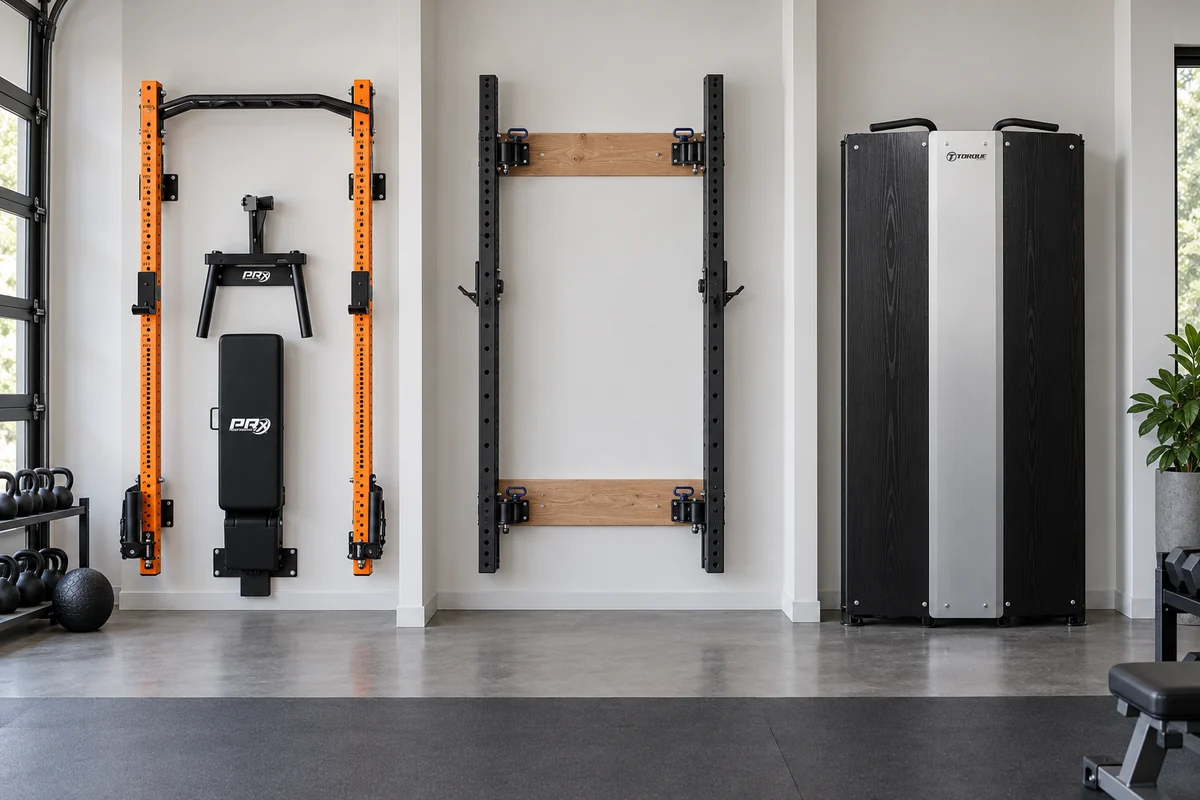
| Fold-back wall rack | Uprights hinge to either side | Barbell lifts and pull-ups; some models add cables | Wall/stringers, hinge clearance, gear storage |
| Cabinet-style cable trainer | Doors close around stationary machine | Cable presses, rows, leg work, pull-ups where included | Closed machine still uses floor space |
| Folding incline trainer | Long glideboard or rails collapse | Incline bodyweight movements | Long exercise footprint when open |
| Portable cable system | Base, handles, or attachments pack down | Cable patterns according to available anchors | Anchoring, cable feel and setup consistency |
| Folding bench | Legs/backrest collapse | Pressing and supported work with separate resistance | Does not provide resistance by itself |
These categories describe storage methods, not interchangeable training experiences. A wall rack supports a barbell but does not include one by default. A closed cabinet can hide cables without vacating the corner. A portable system may require a secure door anchor for certain pull angles. Compare the actual mechanism in product photos and assembly instructions before you commit to a wall or purchase accessories.
A folding rack is a practical candidate if your plan starts with loaded squats and presses. Compare the compatibility, depth and safeties of dedicated power racks; a similarly shaped folded silhouette does not guarantee the same open working area or accessory fit.
3. Test Five Movements Before Choosing Hardware
List one squat or lunge, one hip hinge, one horizontal push, one horizontal pull, and one vertical pull. For each, note the handle or bar position, your stance, where the bench goes, and how resistance can increase over time. Add a vertical press or core exercise if it is central to your training. A machine that misses your essential movements may require enough extra equipment to defeat its space advantage.
For example, an open rack can handle barbell squats, Romanian deadlifts, bench presses, rows and pull-ups with appropriate free weights, bench and safeguards. A dual-pulley station can cover many of the same movement patterns with different loading and anchor geometry. Test cable origins at the top, middle and bottom rather than assuming a generic “full-body” claim guarantees every exercise you want. Dedicated cable machines are another reference point if pulldowns, crossovers and quick load changes dominate your plan.
The five-movement worksheet
Leg: squat or split squat. Hinge: deadlift or cable pull-through. Push: floor or bench press. Row: barbell or cable row. Vertical pull: pull-up or pulldown. Write down the exact attachment or extra equipment required next to each movement.
4. Compare Resistance at the Handle
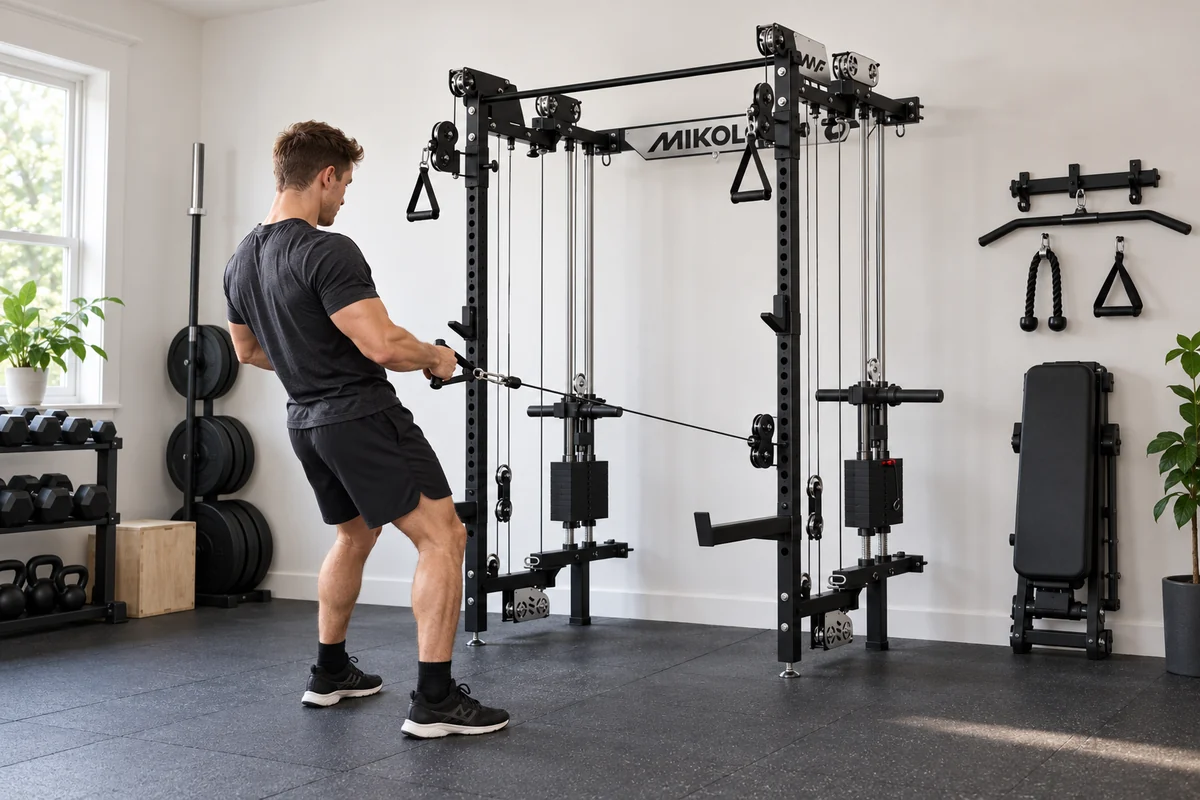
A number printed on a stack, plate, or screen does not always equal the load felt at one cable handle. Pulley ratio, number of independent stacks, friction and the design’s resistance curve affect the comparison. A 2:1 cable setup has roughly half the selected stack load at an individual handle before other mechanical effects; a plate-loaded cable system also needs the actual plates you intend to use. Ask how resistance is specified, whether increments suit beginners, and whether both handles can be loaded at once.
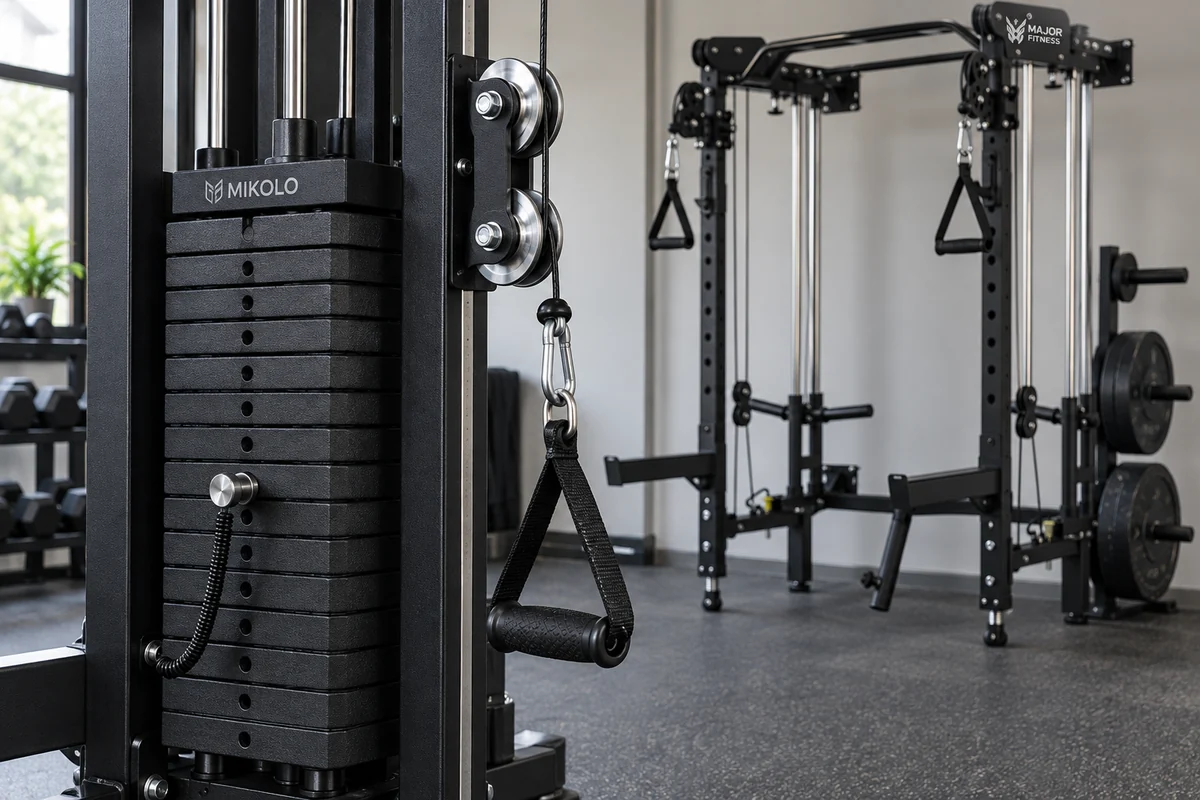
The manufacturer pages illustrate why model details matter: MIKOLO lists a 2:1 pulley ratio for its CHEETAH 2.0 Elite, while Major Fitness describes a 1:1 system on its F35. These examples are not a head-to-head test or a reason to buy either; they show why a stack label and a plate label cannot be treated as the same usable resistance.
Progression also depends on setup. A rack may offer familiar barbell loading if you have sufficient weight plates and safe storage. A cable machine may provide smaller increments and more angles, but it will not recreate the balance and feel of every free-weight lift. Choose the method that lets you progress on the movements you will actually do.
5. Check the Wall, Ceiling, Floor, and Permission
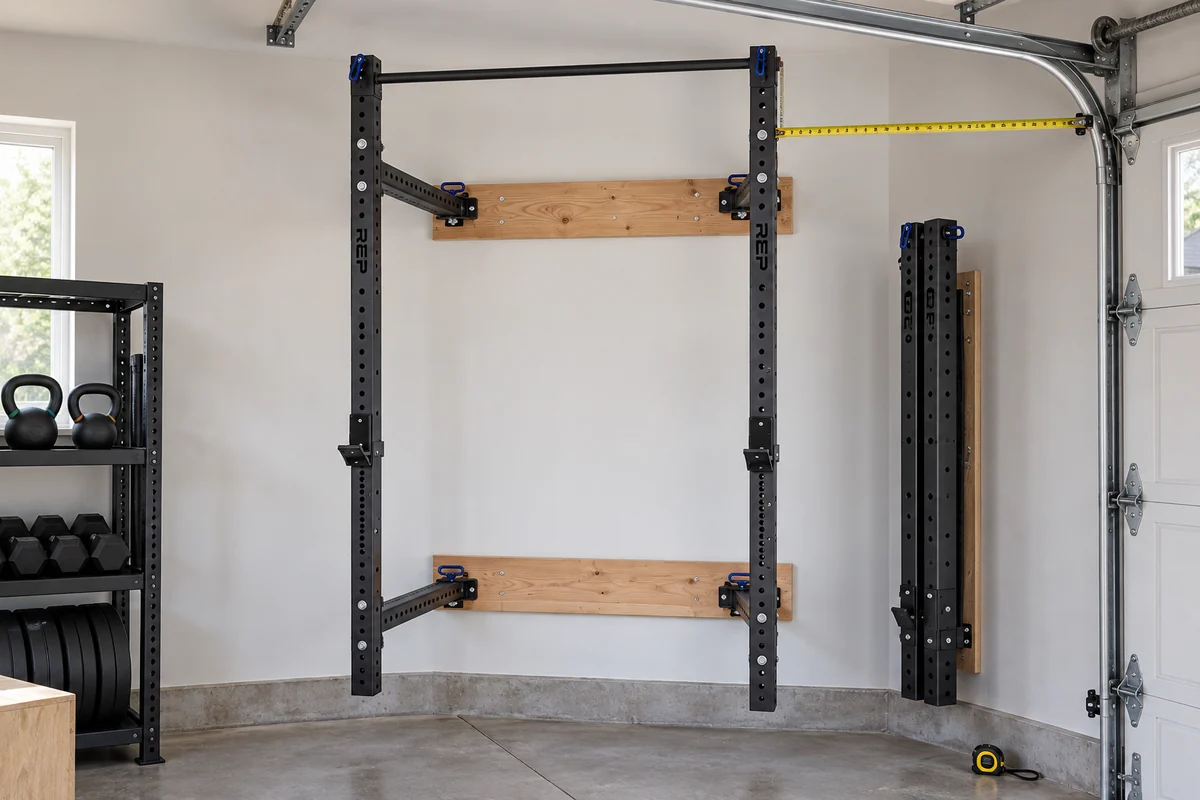
A wall-mounted rack creates an installation project, not just a delivery. Identify the wall material, framing or concrete substrate, stud locations, floor condition, ceiling obstructions, electrical outlets, door tracks and the route from curb to final room. Follow the instructions for your exact model and wall construction. Do not assume drywall by itself is a suitable structural mount; use an installer when the manufacturer or site conditions call for one. Renters should obtain written permission for permanent mounting.
For a specific example, REP states that its PR-4100 does not include wooden stringers and gives model-specific mounting guidance. PRx lists different minimum and recommended ceiling heights across Profile PRO variants; check the height chart for the exact variant instead of assuming any “fold-up” rack fits your garage. These specifications are examples of questions to ask, not universal instructions for other products.
A freestanding machine avoids structural wall mounting but may have a heavy delivery and floor load. Protective gym mats can protect a suitable surface and define a workout zone; they do not increase the load capacity of a floor or fix a bad wall installation. Check the manufacturer’s requirements and the building if you are uncertain about structural capacity.
6. Rehearse Setup, Folding, and Storage
How often will you actually fold the equipment? Rehearse the entire routine on paper: move furniture, unfold the unit, secure each required pin, bring out the bench, load or select resistance, train, put attachments away, and fold the machine again. If the steps feel cumbersome before purchase, they are unlikely to become easier when you are tired after a workout. A household using the room daily may value a quicker fold more than the smallest stored depth.
Do not leave a loaded barbell on a rack unless the manufacturer explicitly approves that procedure, and never treat a pictured folded rack as storage for items shown elsewhere in the frame. Bars, plates, pulldown handles, bench and cable accessories need their own places. Compare folding weight benches by stability, usable positions and stored size; a flimsy bench saves little space if it prevents the presses you bought it for.
Household friction matters too. Can one adult operate the fold safely according to the instructions? Is the route clear for children and pets? Will a car still park in the garage and will doors open fully? Does the equipment block a fire exit or common walkway? These checks are more useful than the shortest catalog “folded depth” taken in isolation.
7. Price the Whole Training Setup
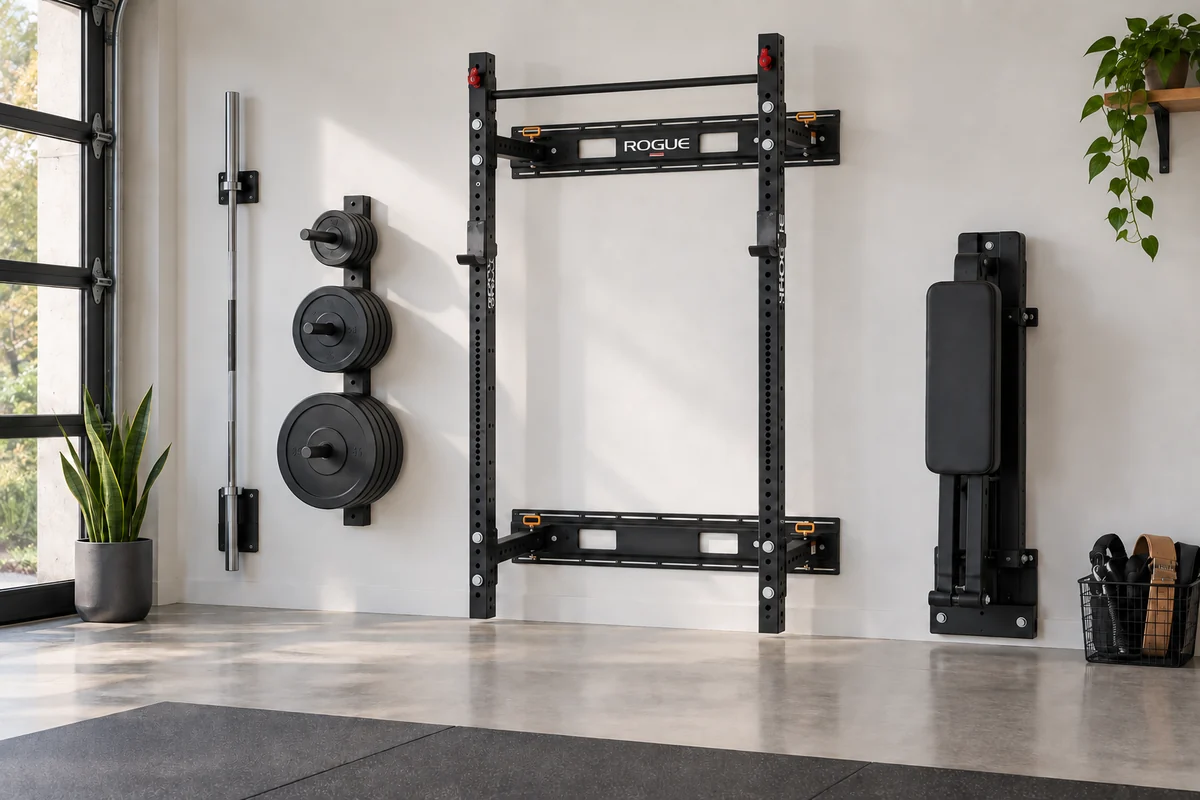
Compare a usable gym, not just a base frame. Add delivery, installation, required mounting materials, barbell, plates, bench, safety hardware, floor protection, handles, maintenance and any software fees. Ask what is included with the exact SKU; lifestyle images sometimes show optional items. A modest rack can cost more than expected when it needs a complete barbell station, while a self-contained trainer may concentrate more of the cost in one purchase.
Also think about future changes. Can you buy a replacement cable or hinge? Will your preferred accessories fit the rack’s actual dimensions and hole spacing? Can you move the unit if your home changes? If a permanent folding station is not appropriate for your room, compare all-in-one home gyms only after checking whether a dedicated open footprint is acceptable. A higher equipment count is not an advantage if setup and storage keep you from using it.
Total-cost formula
Base unit + required mounts + delivery/installation + usable resistance + bench/safeties + flooring/storage + ongoing service. Check the current bundle description, warranty exclusions and return process before treating a promotional price as your final cost.
Match the Machine to the Room
| Your situation | First design to investigate | Verify before purchase |
|---|---|---|
| Rental or shared apartment; no drilling | Portable cable setup, folding bench with weights, or suitable freestanding trainer | Open training zone, equipment weight, noise, anchors and storage |
| Garage; barbell training; limited parking space | Fold-up or fold-back wall rack | Approved wall, ceiling/hinge clearance, car width, plates and safeties |
| Homeowner; cable training plus barbell work | Folding rack with compatible pulley or stack system | Handle load, attachments, cable travel and what stays fixed on the wall |
| Living room; tidy appearance more important than clearing all floor space | Cabinet-style fold-away trainer | Closed footprint, door swing, delivery route and weight |
| Low-tech incline workouts with long floor available | Folding glideboard | Fully open length, incline progression and included accessories |
This table is a starting point. The right choice depends on the specific machine’s manual and the room you have, not on a category label. Mark the floor, rehearse your five core movements, and reject any option that fails a must-have requirement.
Use This Checklist Before Checkout
- Record folded, fully open and exercise-zone dimensions, including ceiling and doorway clearance.
- Write down five essential movements and the exact equipment each requires.
- Confirm the resistance type, load at each handle, useful increments and progression ceiling.
- Check wall material, stud/stringer requirements, floor suitability and permission to install.
- List bar, plates, bench, safeties, attachments and their separate storage locations.
- Rehearse the entire setup and put-away sequence for a typical workout.
- Price delivery, installation, optional gear, service, subscriptions and returns.
- Read the latest manual and compare the SKU in the listing with the SKU in product photos.
Frequently Asked Questions
Is a folding rack enough for a full-body workout?
A folding rack can anchor a full-body strength program when paired with an appropriate barbell, plates, safeties, and sometimes a bench or cable attachment. Check that your chosen setup covers leg, hinge, push and pull movements; the bare rack does not include all of that gear.
Does foldable gym equipment save floor space while I train?
Usually the space advantage is in storage. The machine still needs its full operating footprint, room for the user and enough clearance for bars, bench or cables. Some cabinet-style trainers also keep a substantial floor footprint when closed.
Can I mount a folding rack on drywall?
Do not assume ordinary drywall is a sufficient structural mount. Follow the exact rack manufacturer’s instructions for studs, concrete, stringers and hardware, and seek qualified installation help when the wall or structure is uncertain.
What is the difference between a fold-up and a fold-back rack?
A fold-up rack lifts its uprights toward the wall and needs a suitable upward path. A fold-back rack hinges its uprights sideways and needs room for that swing. Check the actual model’s folded projection, ceiling and wall requirements.
What does a 2:1 cable pulley ratio mean?
Broadly, the force at one handle is about half the selected stack load before friction and other design effects. Verify the manufacturer’s description of the exact model; do not compare the number on a stack directly with barbell weight.
What should I buy first for a small multipurpose room?
Start with the movements and available space. A foldable bench and suitable weights or a compact cable system may fit a room without a mounting wall. Measure the open workout zone and plan storage before buying a larger machine.
Choose for the Workout, Then for the Fold
The best folding setup is the one you can install correctly, use for your essential movements, and put away without making the room unusable. Measure three footprints, check the resistance at the point of use, include every supporting purchase, and follow the manual for your exact model. A smaller folded shape is useful only when the open equipment and the routine also fit your home.

Pingback: Best Power Racks Under $1,000: 3 Popular Amazon Picks