

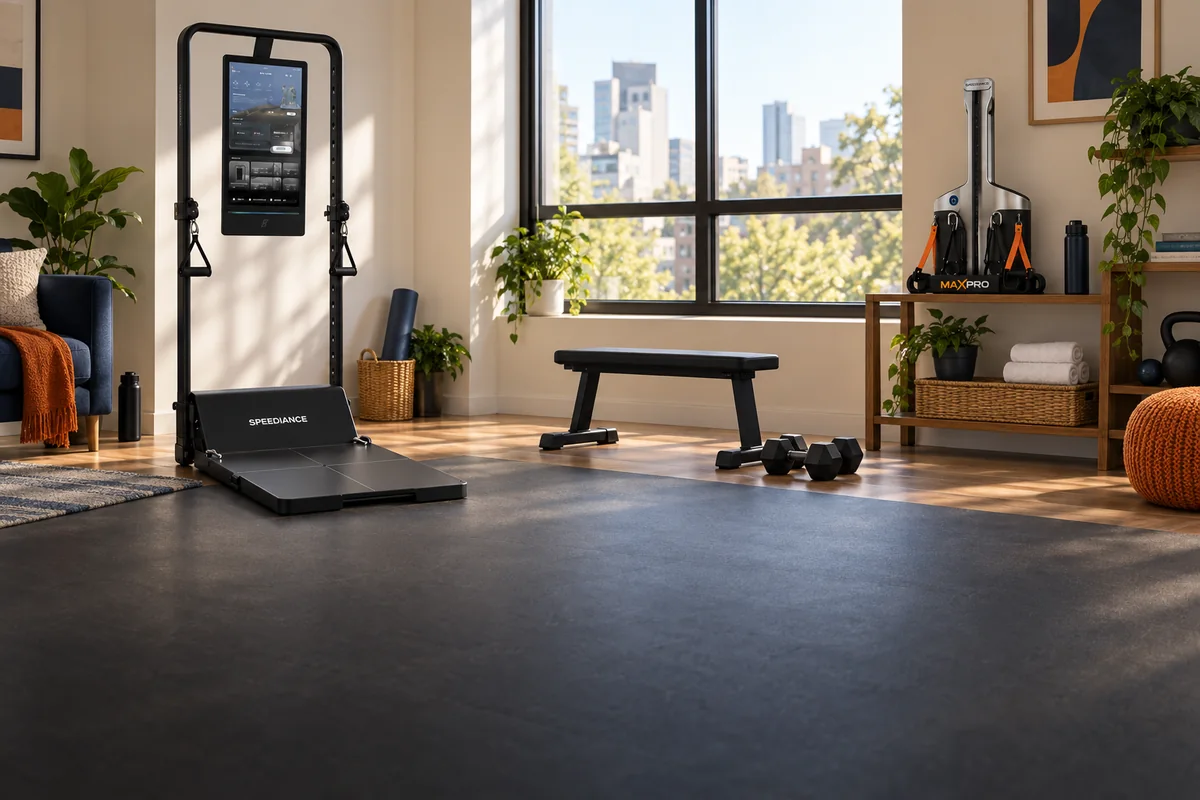
How to Choose a Compact Home Gym
Measure the room, match the resistance to your training, and calculate the true cost before choosing a machine.
A compact gym should make consistent training easier in the space you actually have. A small listed footprint is a start, but it does not tell you whether you can extend a cable, roll out a bench, perform a lunge, or put the machine away when the room becomes an office again. This guide turns those questions into a practical buying process.
The Quick Answer: Choose the Workout First, Then the Machine
If you mostly want guided cable strength work and can keep a small platform in place, a foldable digital system may make sense. A wall-mounted trainer can preserve floor area when your wall and installation situation qualify. A low-profile platform can be easy to store, while a portable cable unit suits a room that must return to normal immediately after training. An incline bodyweight system offers another low-tech route, but check its extended operating length. These are different solutions to different space problems.
Browse compact home gyms only after listing your room measurements, five must-have exercises, maximum storage space, and budget. A device that misses a required movement or blocks a doorway is the wrong purchase even if its footprint looks impressive in an ad.
One-minute decision rule
Reject any candidate that fails one of these checks: it fits the open workout zone, it provides your main exercises at useful resistance levels, it can be installed or stored in your home, and its complete ownership cost fits your budget.
1. Measure the Operating Space, Not Just the Stored Footprint
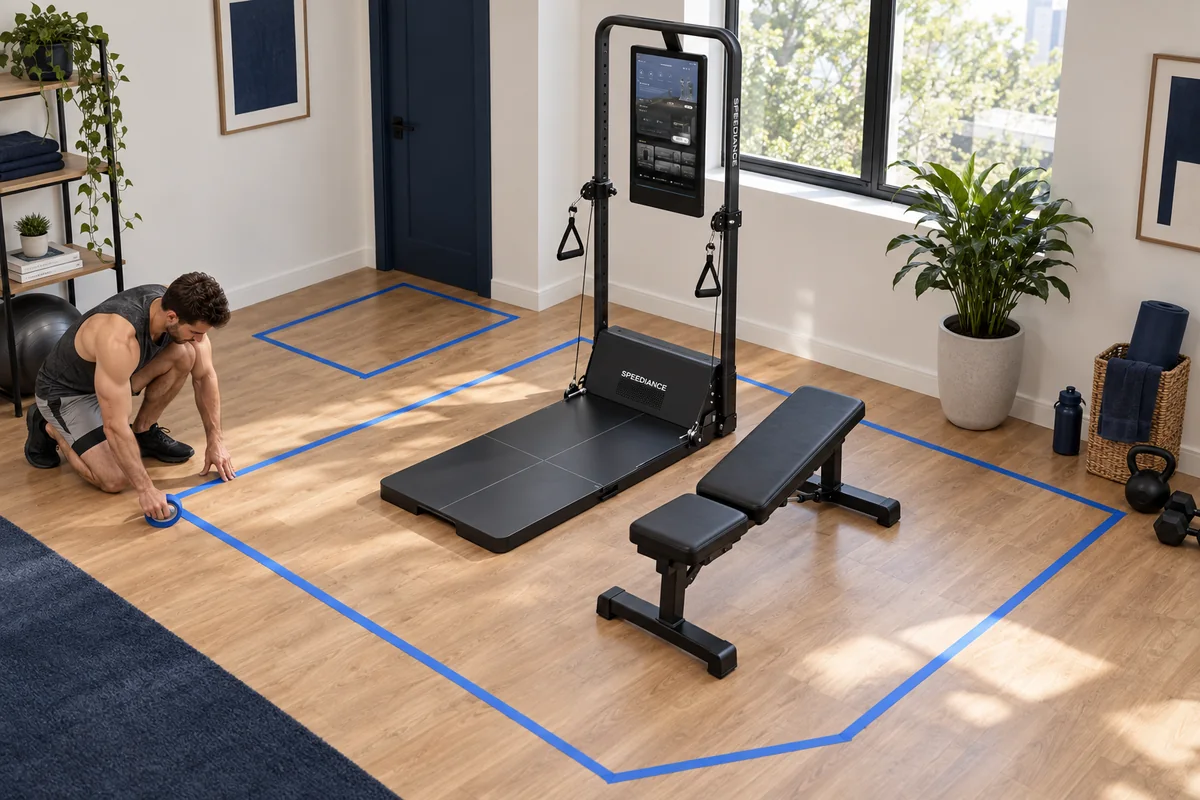
Measure usable width, depth, and ceiling height after accounting for doors, trim, low beams, and the path to an outlet. Record separate dimensions for the machine stored and ready to use. Then draw the complete workout zone: arms moving outward, handles extending across the room, bench travel, room for a squat or split squat, and a safe route around the setup. A wall machine can still require a generous floor area in front of it.
Use painter’s tape to outline the published operating dimensions. Rehearse the exact positions you expect to use: a standing cable row, an overhead press, a floor exercise, and a bench movement if relevant. When two people share the room, allow space for a second person to stand clear of the cables and moving parts. Do not invent a universal clearance number; use the manufacturer’s stated requirements and a tape-measured rehearsal in your own space.
Check the path into the room
Measure the narrowest doorway, hallway turn, stairs, and elevator—not only the final room. Compare those numbers with carton dimensions and the heaviest individual component. In an upstairs apartment, check building rules and the floor’s suitability for the machine plus the user. A mat can protect a surface or reduce some vibration; it cannot increase the structure’s load capacity.
2. Compare the Main Types of Compact Home Gym
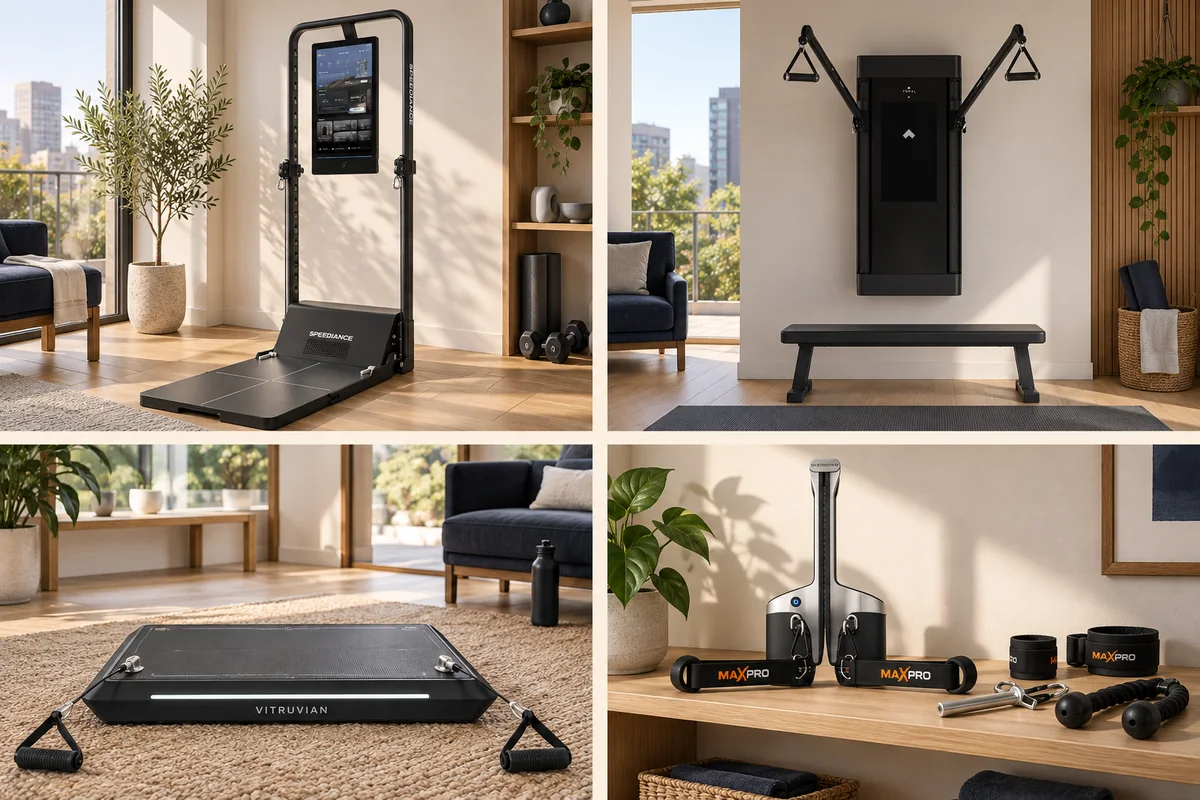
Product labels often overlap. The most useful distinction is what must remain in the room, how resistance is created, and how the unit changes between storage and use. Conventional all-in-one home gyms can include a rack, Smith bar, and multiple cable stations, but many require a dedicated training area. A compact system usually gives up some station variety to save floor space.
| Type | Space advantage | Potential limitation | Best fit |
|---|---|---|---|
| Folding digital cable trainer | Can fold or roll into a smaller stored position | Power, controls, software, and setup routine vary | Shared rooms with an available outlet |
| Wall-mounted digital trainer | Little machine footprint on the floor | Wall eligibility, installation, and floor space in front | A fixed training wall in a suitable home |
| Low-profile digital platform | Flat unit can be stored under suitable furniture | Cable angles and stability depend on accessories and movement | Minimal visual clutter between workouts |
| Portable cable unit | Can pack away or move between locations | Anchor options and resistance feel vary by exercise | Multiuse rooms and travel |
| Incline bodyweight trainer | Can fold without electronics | Extended length may be substantial | Low-tech training where floor length is available |
For a room that doubles as a bedroom or office, explore folding gym equipment while timing the setup and put-away process. A small stored dimension is less valuable if repeated assembly discourages you from exercising.
3. Make a Five-Exercise Test for Your Training Plan
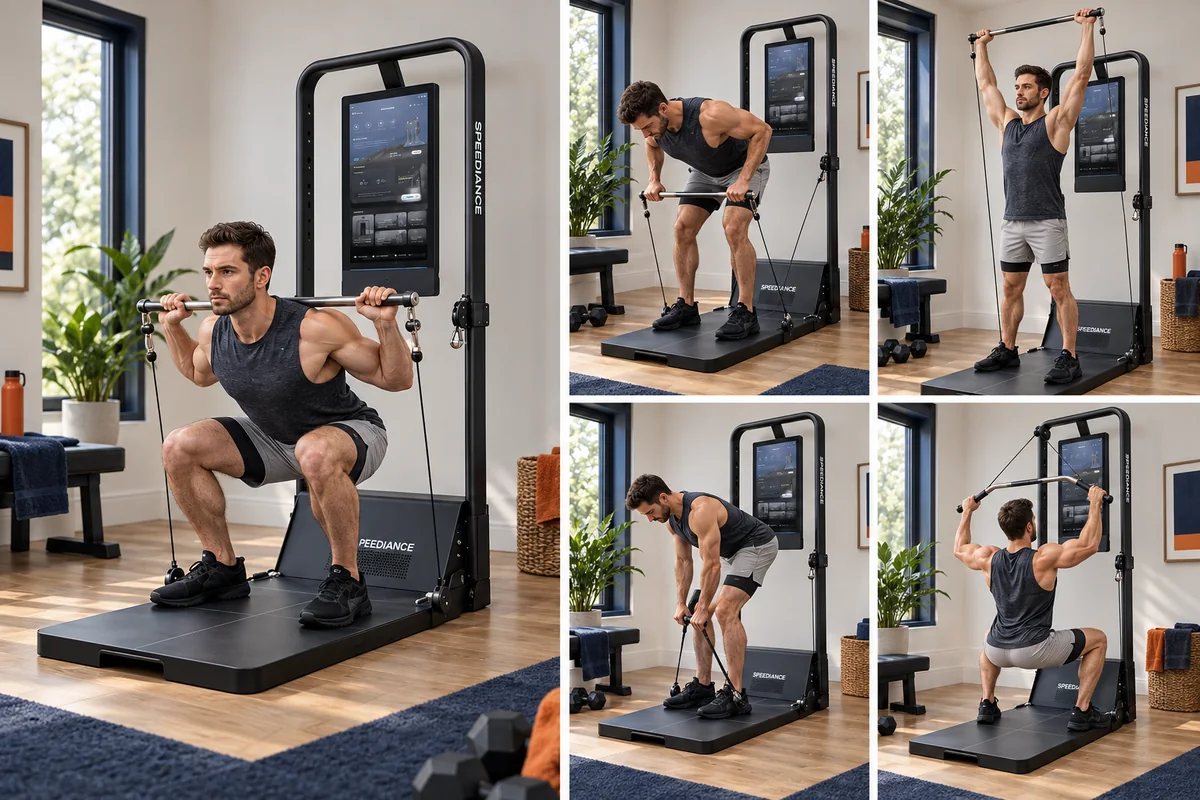
Ignore a headline claim of hundreds of exercises until you verify the movements you will repeat each week. Write down five essentials, such as a squat or squat variation, hip hinge, horizontal push, horizontal pull, and vertical push or pull. Add unilateral leg work or core training if those matter to you. For each move, check starting position, handle path, attachment, resistance range, and whether the machine lets you progress over time.
Some compact systems support cable squats and presses but do not replicate the setup of a barbell rack. A pulley’s location affects the line of pull; different cable ratios and training modes can change the resistance felt at the handle. If precise cable angles are your main priority, compare dedicated cable machines as well as compact systems. Also ask whether both arms can be used at once at the loads you need.
Plan how the machine will support a repeatable schedule rather than relying on a large exercise library. The CDC recommends muscle-strengthening activity on at least two days per week for adults, alongside aerobic activity. Your equipment choice should make that schedule realistic in your home; it does not have to reproduce every exercise found in a commercial gym.
4. Compare Resistance and Progression Honestly
Published maximum resistance is only one number. Check the minimum starting load, the smallest adjustment, the maximum load for a specific movement, whether the stated number is per cable or combined, and whether resistance differs during lifting and lowering. For weight-stack systems, pulley ratios can make the load at the handle differ from the labeled stack weight. For digital trainers, manufacturer modes may change the resistance profile; try a demonstration when possible.
A machine should be light enough for controlled warm-ups and challenging enough for the exercises you will perform later. If two adults will use the system, write down both users’ working ranges. Also assess movement range: short cables may limit overhead positions for tall users, while an awkward anchor point may compromise rows or presses.
If you primarily value simple strength progression and independent loading, consider adjustable dumbbells alongside the machine rather than assuming a single digital gym must cover every exercise. A hybrid setup can take little space and provide more useful movement options than an expensive machine with the wrong cable geometry.
5. Check Installation, Power, Storage, and Household Fit
Wall and power requirements
Before considering a mounted machine, confirm approved wall construction, stud spacing, clearances, outlet location, landlord or building permission, and any professional installation requirement. For example, Tonal describes its system as professionally wall-mounted. Do not assume drywall anchors or a do-it-yourself installation will satisfy a manufacturer’s requirements. For powered systems, find out what happens during an internet or power outage and which features remain available without an active membership.
Benches and small accessories
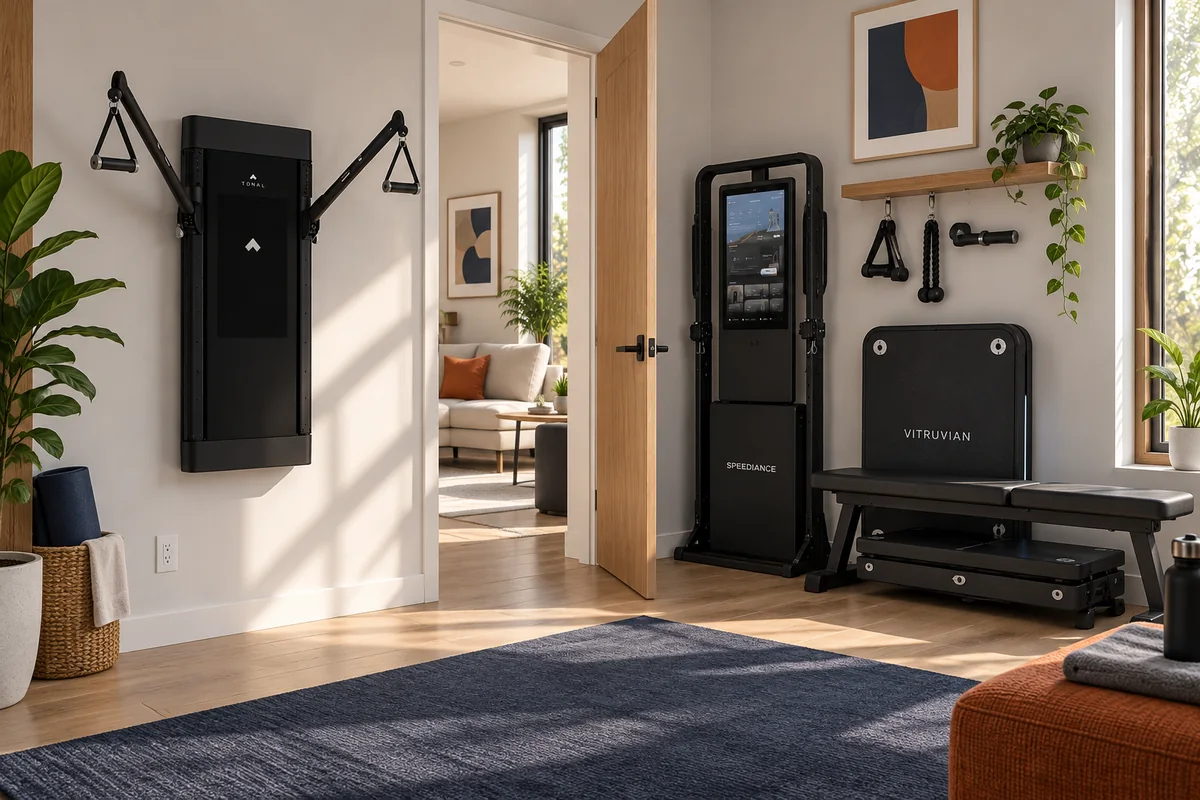
A trainer that appears compact in product photos may need a separate bench for chest work, seated rows, or split squats. Measure where it will sit during use and where it will go afterward. Compare weight benches by usable height, stability, adjustment range, and compatibility with the machine’s cable paths. Store attachments where they are easy to reach without leaving them in a walkway.
Choose gym mats for the floor finish and intended training style, then check the manufacturer’s instructions for placement and ventilation. Make sure an installed mat does not block a folding hinge, prevent leveling, or trap moisture under the machine.
6. Calculate the Total Cost of Ownership
Compare more than the advertised machine price. Add shipping, delivery, assembly or professional installation, required accessories, bench or mat, sales tax, and any recurring app or membership cost. Read what happens if you cancel the subscription: Does basic manual resistance remain available? Can you access saved workouts? Can another household member create a profile? Policies vary, so check the current product page and terms before buying.
Simple ownership estimate
Estimated three-year cost = equipment + delivery and setup + necessary accessories + 36 months of required subscriptions + expected maintenance. Enter current prices yourself; promotions, financing terms, service plans, and taxes can change quickly.
Compare return windows, repackaging fees, warranties on electronics versus frames, replacement parts, and service availability at your address. For a heavy machine, returns can involve more than printing a shipping label. A lower sticker price is not necessarily better value if a core attachment is extra or the system cannot perform your primary workout.
7. Match the Gym Type to Your Living Situation
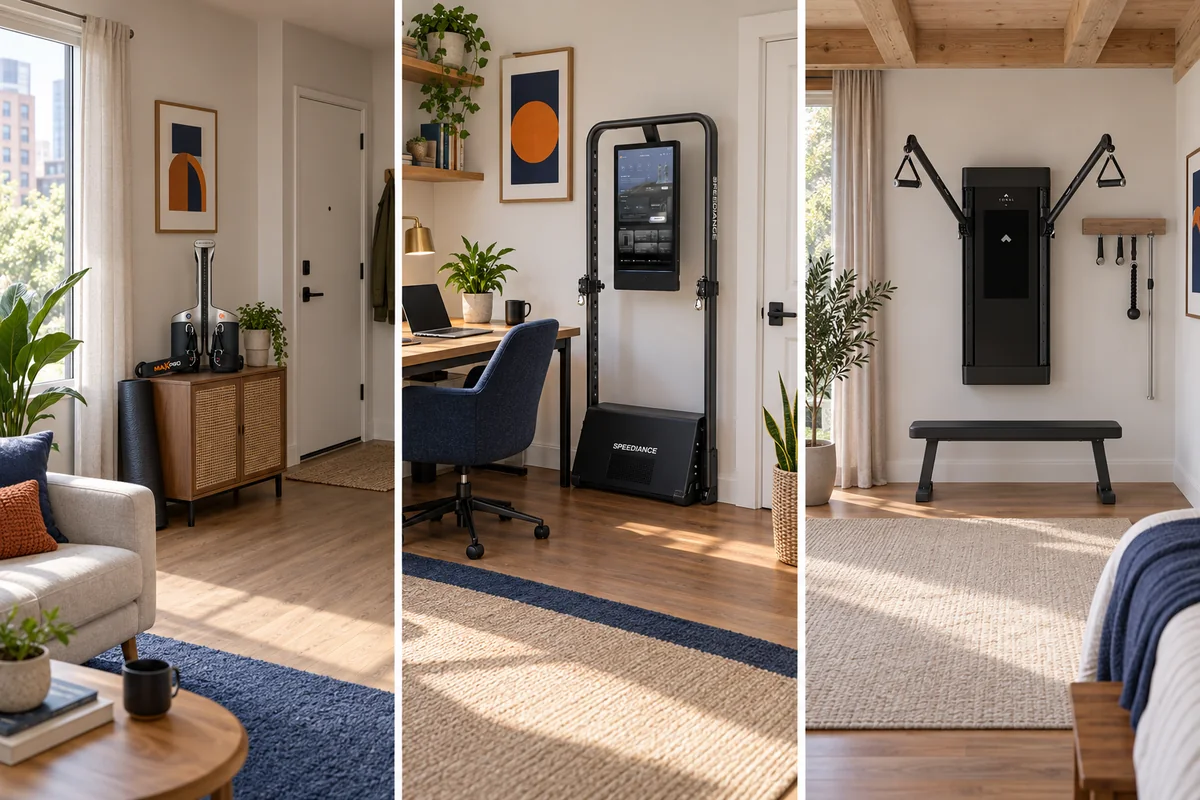
Apartment renter
Start with non-permanent, foldable, or portable systems. Check noise, downstairs neighbors, storage after workouts, building rules, and outlet access. Reject wall-mounted choices unless your lease and approved installation allow them.
Dedicated spare room
Prioritize the best cable geometry and progression for your training over the tiniest stored footprint. A permanent station can be practical when it leaves enough room for a bench and full-range movement.
Multipurpose office
Look for fast setup and a predictable storage spot. Time the daily transformation of the room and confirm the machine does not block your desk, chair, or normal walking route.
Two-person household
Check each person’s height, starting loads, preferred exercises, and whether profiles or a second station are needed. A single pair of handles may not support simultaneous workouts.
Give each candidate a score from 1 to 5 for workout fit, operating space, storage, setup, ownership cost, and support. Double the weight of your two most important categories. Any failure in safety, installation eligibility, or a must-have exercise is a rejection rather than a small score deduction.
Compact Home Gym Buying Checklist
- Measure the full workout zone, stored footprint, ceiling, doorway, and delivery route.
- List five essential movements and verify cable paths, accessories, and movement range.
- Check starting resistance, increments, effective load, and progression for every user.
- Confirm wall, floor, power, internet, and building or rental requirements.
- Account for a bench, mats, attachment storage, and room to enter and leave safely.
- Compare the complete three-year cost, including any required membership.
- Read the current return policy, warranty exclusions, service area, and parts availability.
Common Buying Mistakes
Buying from a folded photo: The machine may extend far into the room when in use. Check unfolded dimensions and movement clearance. Chasing a maximum weight number: Resistance modes and cable ratios may make the number unsuitable for direct comparison. Ignoring the setup routine: A unit that takes too much work to deploy can become an expensive stored object.
Forgetting recurring charges: An appealing up-front deal can become costly if essential features require a paid plan. Assuming a wall is suitable: A mounted device needs the manufacturer’s approved structure and installation method. Overbuying features: A simpler setup you use consistently is more valuable than a long exercise list you never need.
Frequently Asked Questions
How much room do I need for a compact home gym?
There is no single room size that fits every model. Measure the manufacturer’s operating dimensions, then allow for your own cable reach, body position, bench movement, doors, and safe access. Tape the layout onto the floor before ordering.
Is a wall-mounted home gym better for a small apartment?
It can free floor area around the machine, but the workout still needs floor space in front of the wall. You must also confirm approved wall construction, installation, outlet access, and permission from the landlord or building.
Can a compact home gym replace free weights?
It can cover many strength movements, but the answer depends on your preferred exercises and the machine’s resistance, cable angles, and attachments. If barbell-specific training is essential, a compact cable system may be a supplement rather than a replacement.
Do compact smart gyms require a subscription?
Policies differ by brand and model. Some features may require a membership, while others may work in a basic mode. Confirm current terms, which functions remain after cancellation, and the total subscription cost before buying.
Is a folding machine always easier to store?
No. Check the folded size, weight, wheel design, clearance needed to fold it, and where the unit and accessories will actually live. A folding machine that blocks a closet or door may be less convenient than a fixed setup.
What should a beginner buy first?
Start with a repeatable full-body plan and a realistic space budget. Choose a compact machine only if it supports your main movements and fits both your operating and storage areas; otherwise begin with simple, versatile equipment and expand later.
The Right Compact Gym Fits Your Routine
Choose the system you can use safely and regularly in the room you already have. Measure first, test your essential movements against the machine’s real capabilities, and price the whole setup. The best result is a training space that is easy to start using and easy to live with afterward.

Pingback: Best Power Racks Under $1,000: 3 Popular Amazon Picks