

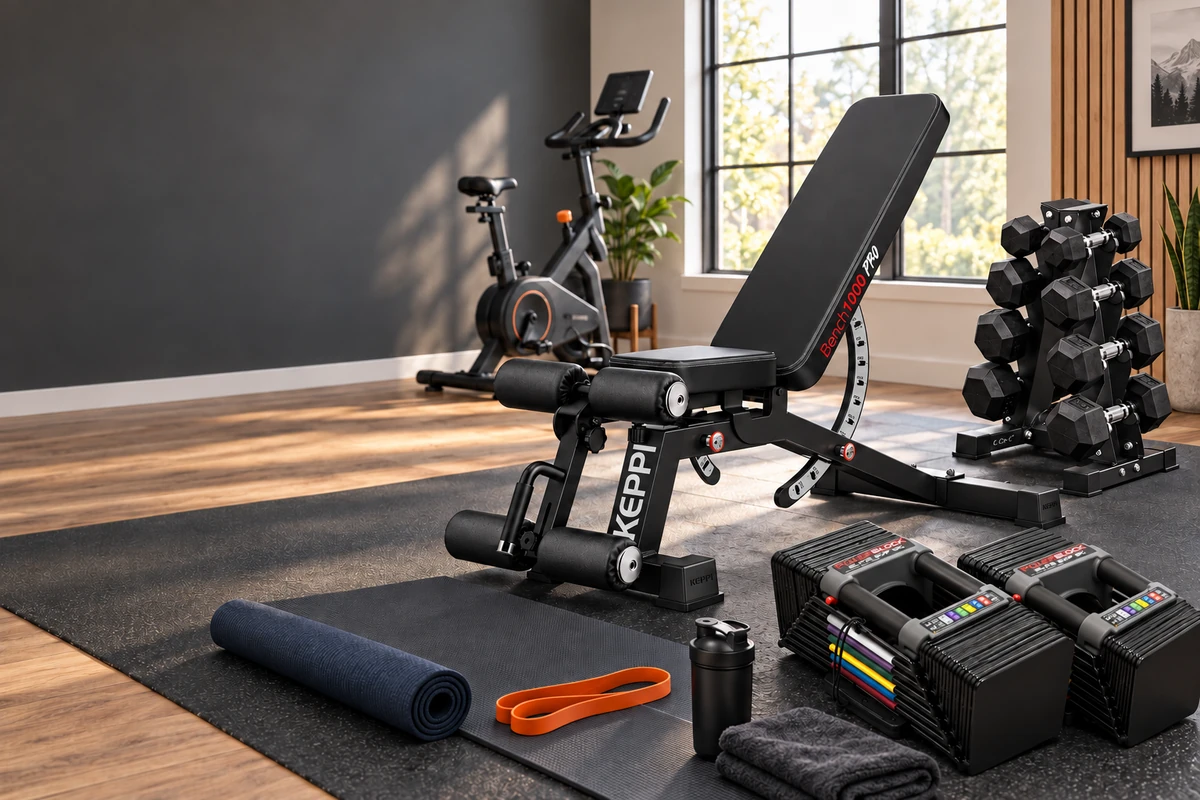
Gym Gear Pilot • Beginner Home Gym Guide
Best Home Gym Equipment for Beginners in 2026
Build a useful home gym without buying a room full of equipment. This practical guide shows what to buy first, what can wait, and how to match each purchase to your goals, space, and budget.
The smartest beginner setup is not the biggest one. For most people, the best home gym equipment for beginners is a compact mix of adjustable resistance, a stable training surface, and one cardio option you genuinely enjoy. Start with enough equipment to train your whole body, then expand only when your routine exposes a real limitation.
Quick Answer: What Should a Beginner Buy First?
Begin with resistance you can scale, enough open floor space to move safely, and a simple plan you can repeat two or three times per week. A pair of adjustable dumbbells plus resistance bands covers the broadest range of movements in the smallest footprint. Add a bench when floor-based pressing and supported rowing no longer meet your needs, then choose cardio equipment based on comfort and consistency.
Smallest useful setup
Adjustable dumbbells, bands, an exercise mat, and approximately 6 × 8 feet of clear space.
Best upgrade order
Bench first, flooring second, then a cardio machine or heavier resistance when your training requires it.
What can wait
A power rack, barbell set, cable station, and specialized machines are useful only after you know you will use them.
For a useful health baseline, the CDC says adults should work toward at least 150 minutes of moderate-intensity aerobic activity per week and muscle-strengthening activity on two days. HHS also advises inactive adults to start with small amounts and build gradually. Your first home gym should make that progression easier—not turn it into a complicated shopping project.
Sources: CDC adult activity guidance and HHS Physical Activity Guidelines Q&A.
Beginner Home Gym Essentials at a Glance
| Equipment | Why It Earns Space | What to Check | Priority |
|---|---|---|---|
| Adjustable dumbbells | Train legs, back, chest, shoulders, and arms with one compact pair. | Weight range, increment size, handle comfort, lock security, warranty. | Buy first |
| Resistance bands | Add light resistance, warm-ups, assisted movements, and travel-friendly training. | Clearly marked resistance, durable anchors, replaceable components. | Buy first |
| Exercise mat or rubber flooring | Defines the workout zone, improves grip, and helps protect the floor. | Thickness, density, odor, traction, flooring compatibility. | Buy first |
| Adjustable bench | Expands pressing, rowing, split-squat, and seated-exercise options. | Stability, pad gap, back angles, footprint, rated capacity. | Next upgrade |
| Cardio equipment | Provides a convenient, repeatable way to accumulate aerobic activity. | Joint comfort, noise, stored size, user capacity, service support. | Goal dependent |
| Storage | Keeps walkways clear and makes short workouts easier to start. | Load rating, access, stability, wall or floor clearance. | As needed |
1. Adjustable Dumbbells: The Best Strength Foundation
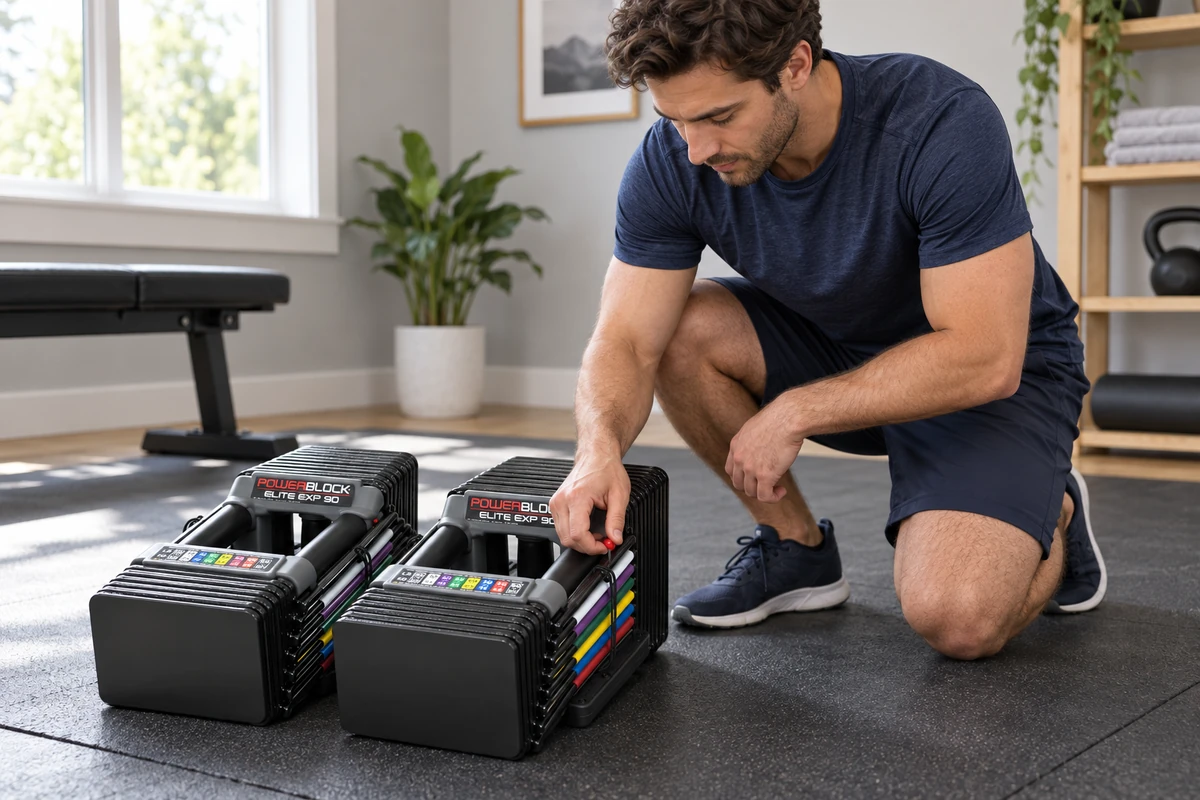
For most new lifters, adjustable dumbbells for beginners provide the best blend of exercise variety and space efficiency. One pair can replace a small rack of fixed weights while supporting goblet squats, Romanian deadlifts, floor presses, rows, overhead presses, carries, curls, and triceps work.
Look for a starting weight that feels manageable for smaller upper-body movements and a top weight that leaves room for stronger leg and back exercises. Small adjustment increments are especially useful at the beginning because a 10-pound jump can be disproportionate on lateral raises or overhead presses. The selector should lock positively, weight markings should be easy to read, and the dumbbell should remain balanced during controlled repetitions.
Dial and selector-pin systems change quickly, but they should be returned carefully to their cradles. Plate-loaded handles are slower yet generally simpler and easier to expand. Avoid dropping any adjustable design unless the manufacturer specifically permits it; internal selection parts may be less tolerant of impact than solid fixed dumbbells.
2. A Stable Weight Bench: The Most Useful Upgrade
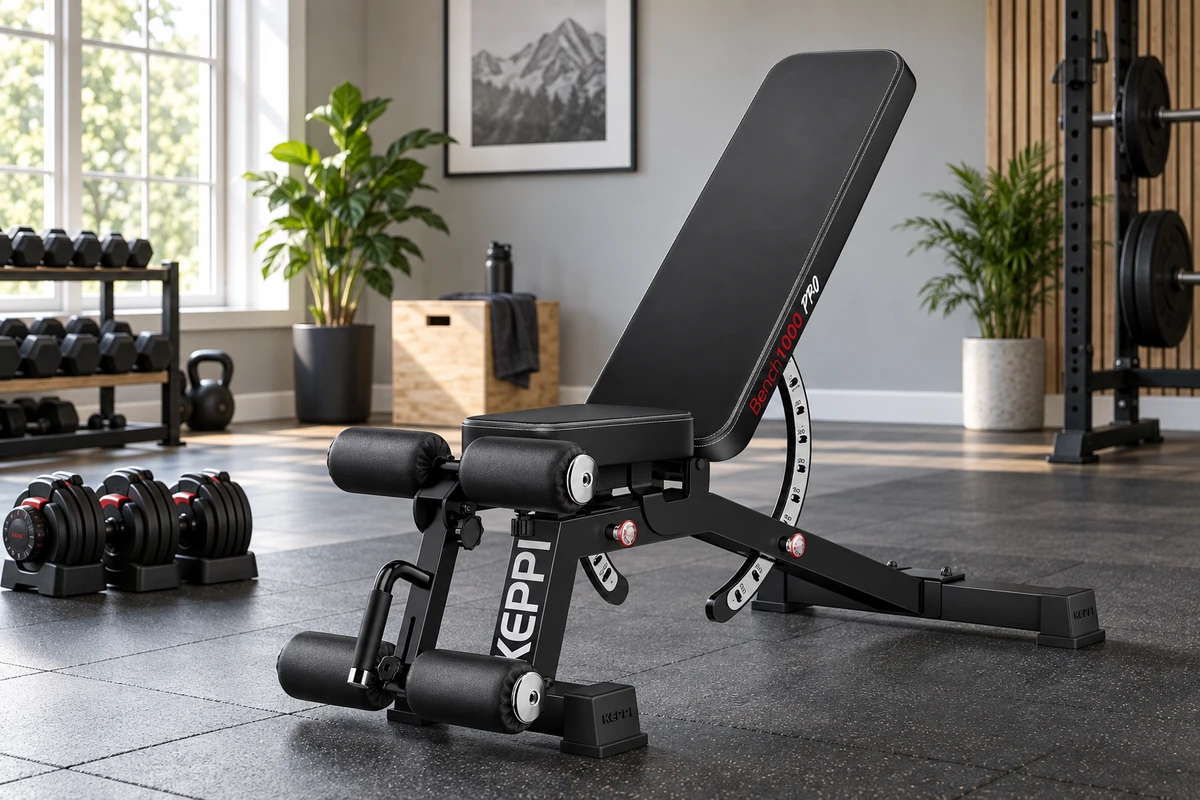
A bench is not mandatory on day one—you can perform floor presses, bridges, rows, and many lower-body exercises without one. However, well-built weight benches for home gyms expand range of motion and make supported exercises more comfortable. An adjustable model offers flat, incline, and upright positions; a flat bench is simpler, usually lighter, and may feel more stable for the price.
Prioritize a broad base, minimal side-to-side movement, a grippy pad, secure adjustment points, and a clearly stated user-plus-weight capacity. Check both the bench’s open footprint and its storage position. A folding bench is only helpful if the folding mechanism is easy enough that you will actually use it.
3. Resistance Bands: Low-Cost Variety and Assistance
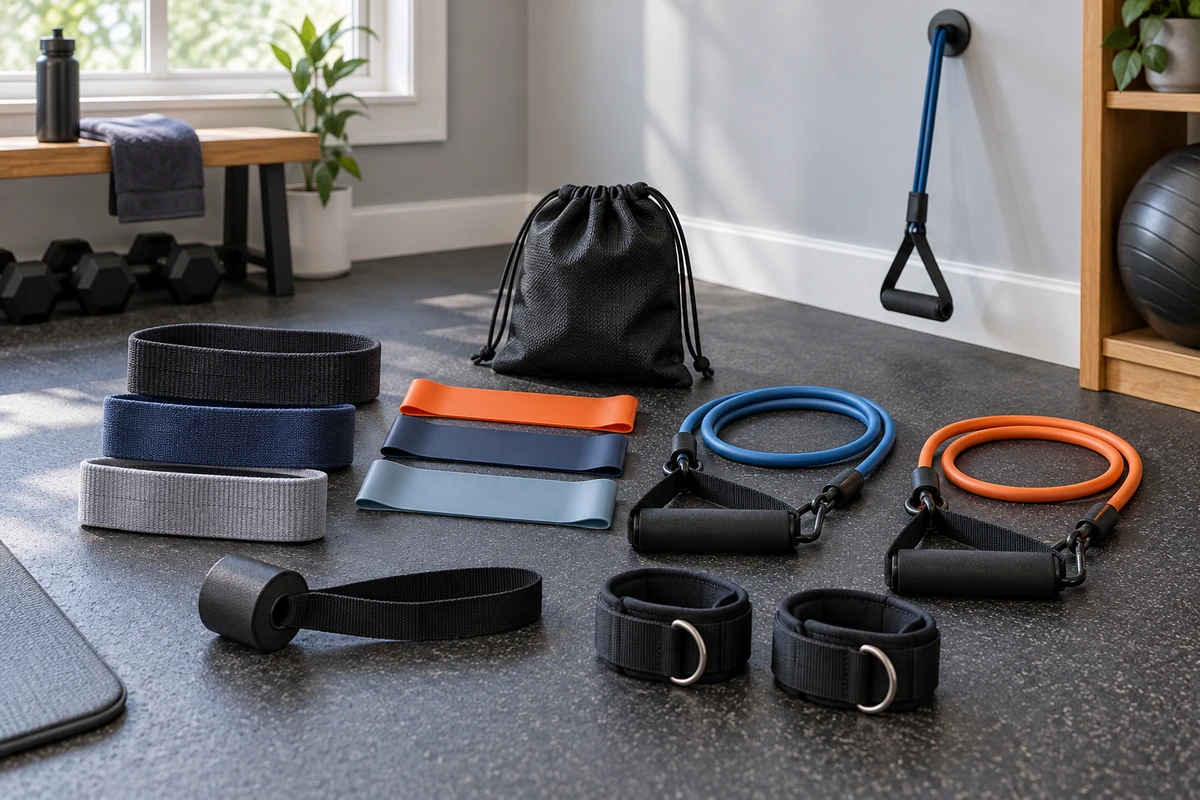
A basic set of resistance bands for beginners adds movements that dumbbells may not replicate conveniently, including pull-aparts, face pulls, assisted pull-ups, lateral walks, and banded warm-ups. Loop bands work well for lower-body drills and assistance, while tube bands with handles can support presses, rows, and curls.
Inspect bands before every use. Retire any band with cuts, cracks, thin spots, or damaged stitching. Anchor it only to a smooth, stable point rated for the pulling direction, and never place your face directly in the line of recoil. Resistance labels are not perfectly standardized across brands, so judge bands by controlled form and usable tension instead of color alone.
4. Flooring and a Mat: The Safety Layer People Forget
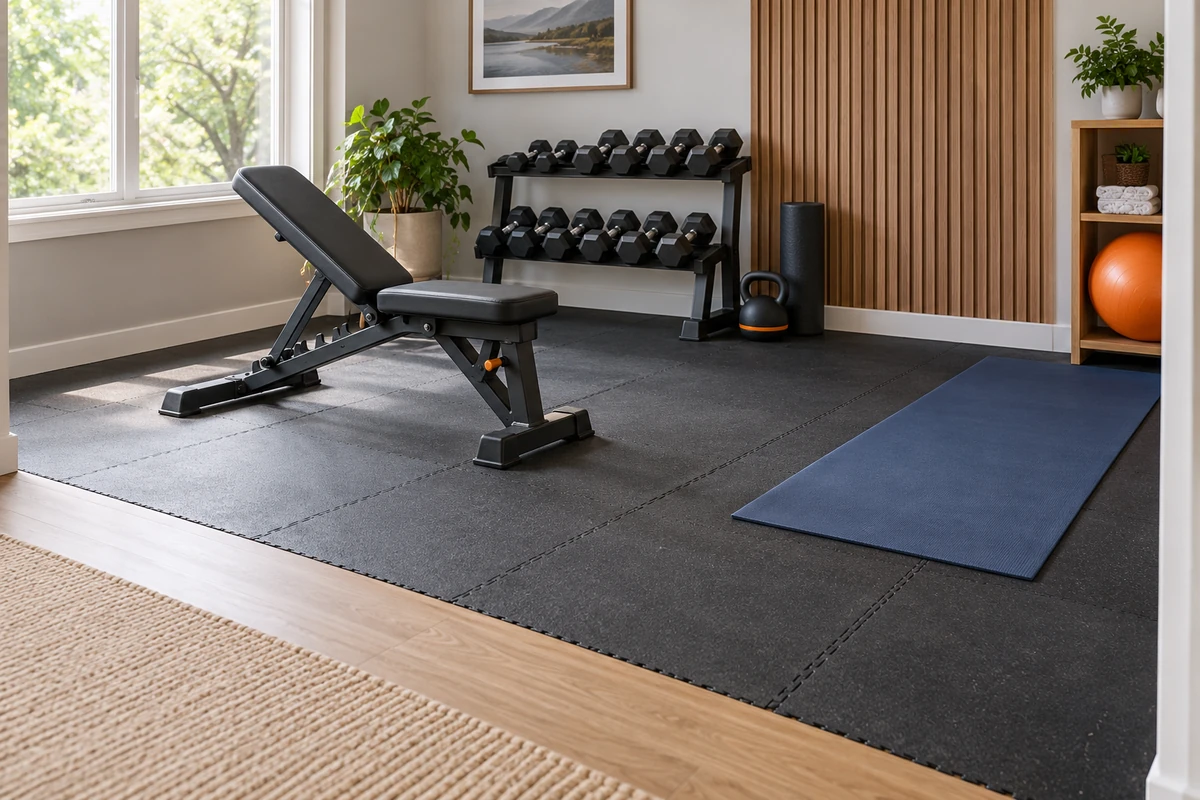
Good home gym flooring improves traction, defines your workout area, and reduces direct wear on the floor. Dense rubber tiles or a purpose-made equipment mat are appropriate under weights and cardio machines. A softer exercise mat is better for mobility and floor work, but it may compress too much under a heavy bench.
Choose material based on the room. Rubber can mark some delicate surfaces, and certain products have a noticeable initial odor, so verify flooring compatibility and ventilation needs. Keep interlocking seams flat, leave doors and vents unobstructed, and do not assume a mat makes dropping weights safe. Impact control still depends on the equipment, subfloor, and training style.
5. Cardio Equipment: Choose the Option You Will Repeat
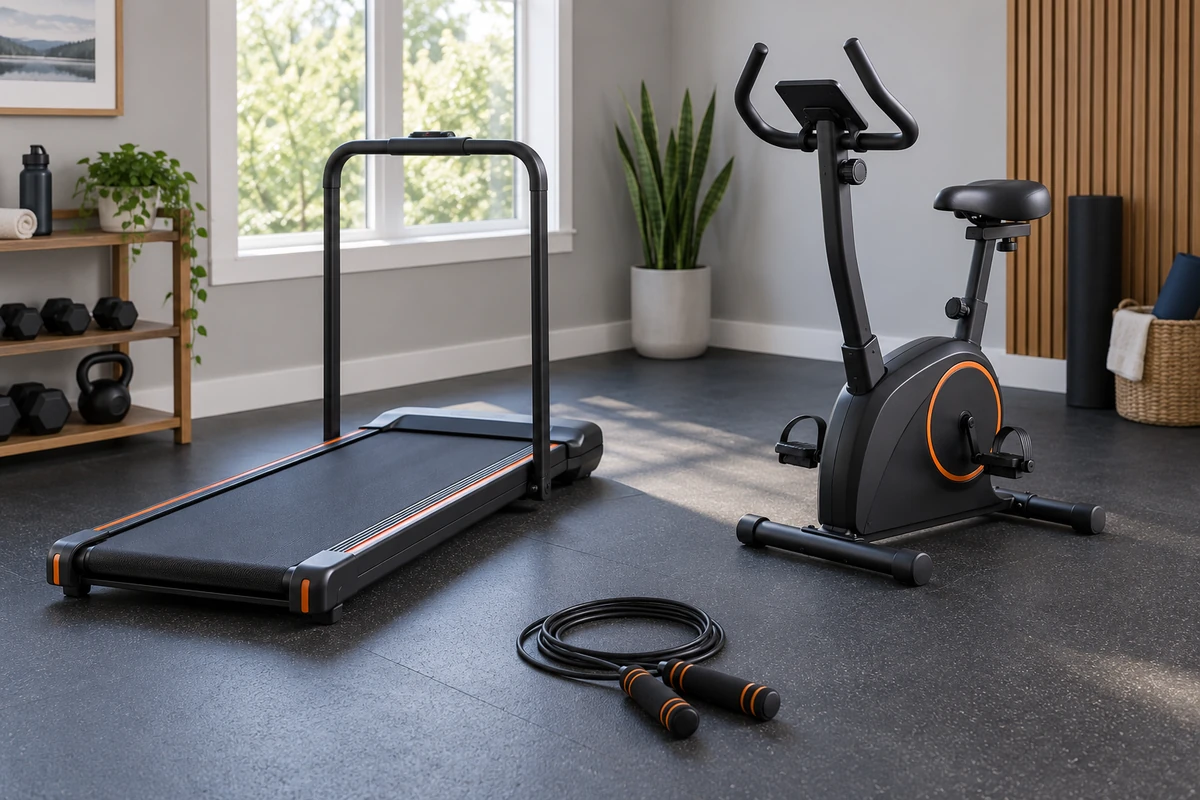
The right cardio equipment for beginners is the machine or tool that fits your joints, room, schedule, and preferences. A walking pad has a low learning curve and stores easily, but compact models may have shorter decks and lower top speeds. An exercise bike is seated and comparatively space efficient, while an elliptical offers a longer stride and usually requires more floor and ceiling clearance. A jump rope is inexpensive but higher impact and less neighbor-friendly.
| Option | Best For | Watch For |
|---|---|---|
| Walking pad or treadmill | Simple walking sessions and gradual progression. | Deck length, handrails, motor duty, noise, incline, storage method. |
| Exercise bike | Low-impact seated cardio and interval control. | Fit range, seat comfort, resistance feel, stability, subscription needs. |
| Elliptical | Full-body, lower-impact rhythmic movement. | Stride length, ceiling height, assembled footprint, machine weight. |
| Jump rope | Portable conditioning when impact and noise are acceptable. | Ceiling clearance, floor surface, rope length, gradual volume. |
Do not buy on calorie-display claims alone. Console estimates vary, and the most effective choice is usually the one you can use consistently at an appropriate intensity. If possible, test stride, seat position, pedal spacing, and controls before committing.
Optional Add-Ons That Can Wait
Optional equipment should solve a specific training problem. A doorway pull-up bar is valuable for vertical pulling only if the frame and bar are compatible and secure. A kettlebell adds ballistic and offset-loaded movements, but adjustable dumbbells can cover many beginner patterns first. A foam roller may support warm-up or self-massage preferences, while a compact rack keeps weights off the floor and removes trip hazards.
- Pull-up bar: useful when you can install it safely and have a progression plan.
- Kettlebell: worthwhile for swings, carries, and compact conditioning.
- Suspension trainer: versatile, but its anchor must match the installation instructions.
- Storage rack: a practical upgrade once equipment begins to block usable floor space.
- Power rack and barbell: best reserved for people committed to barbell training and able to provide adequate space and safety equipment.
Three Beginner Home Gym Budget Plans
Prices and promotions change, so use these as allocation plans rather than fixed shopping totals. Compare delivered cost, warranty coverage, return terms, and replacement-part support before ordering.
Lean starter
Put most of the budget into bands, a mat, and one modest dumbbell solution. Use walking outdoors or bodyweight circuits for cardio.
Balanced setup
Prioritize adjustable dumbbells, a stable bench, protective flooring, and simple storage. This suits general strength and fitness.
Room to grow
Choose a higher dumbbell ceiling, a more adjustable bench, thicker flooring, and a preferred cardio machine with reliable support.
Spend where failure matters: stability, locking mechanisms, user capacity, electrical safety, and service support deserve priority. Screens, app subscriptions, and oversized exercise libraries are secondary if the core equipment is uncomfortable or awkward to use.
How to Plan a Small Home Gym
Many people need compact home gym equipment, but folded dimensions tell only part of the story. Measure the equipment, the room, and the space needed to use it. A bench needs room for your body and dumbbells on both sides; a treadmill needs the manufacturer’s recommended clearance; overhead presses require ceiling height plus arm and equipment length.
- Mark the training zone. Use painter’s tape to outline the open dimensions of major equipment.
- Test movement paths. Simulate lunges, presses, rows, and getting on and off the machine.
- Protect access. Keep doors, electrical panels, windows, vents, and emergency routes clear.
- Check delivery. Compare box dimensions and weight with stairs, hallways, elevators, and doorways.
- Assign storage. Every small item should have a reachable place that does not create a trip hazard.
What Beginners Usually Do Not Need
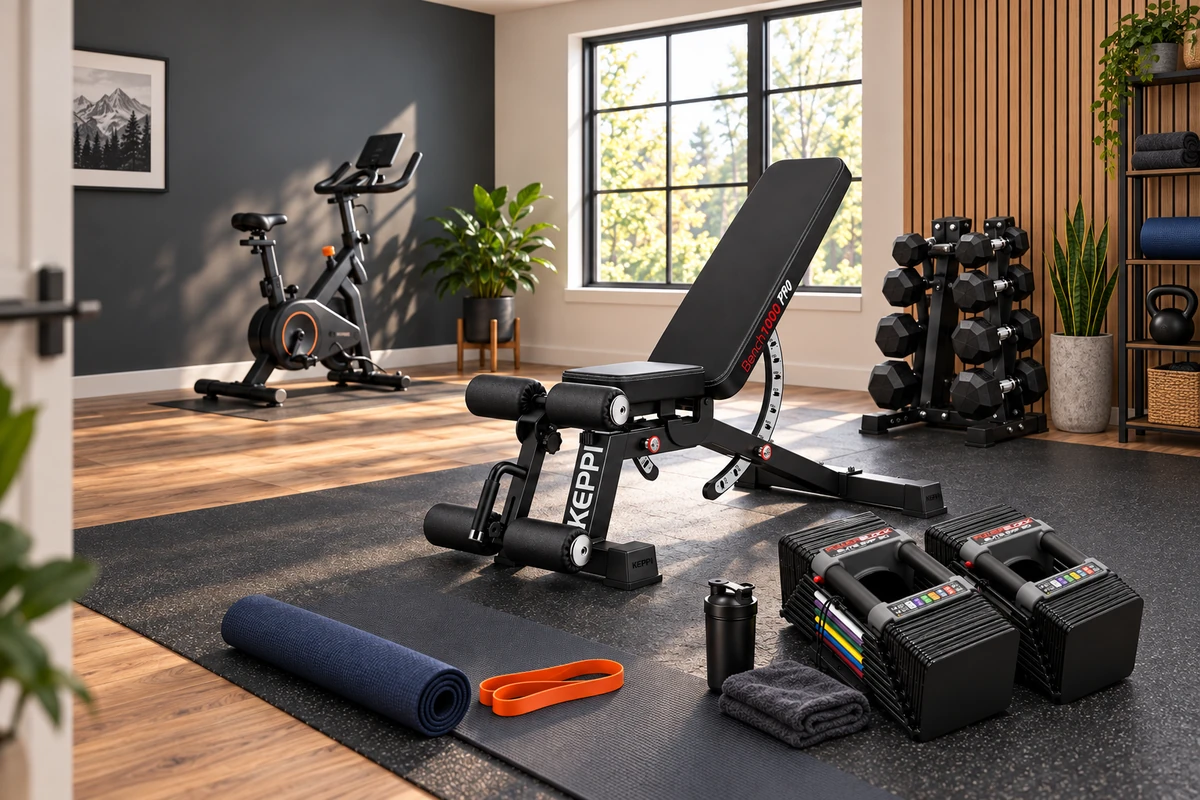
A complete home gym on day one often creates more friction than motivation. Specialized ab machines, single-purpose stations, and large plate-loaded systems may be useful later, but they consume space before you know which exercises you prefer. Likewise, buying the heaviest possible equipment does not guarantee a better progression path if the lowest setting is already too challenging.
- A collection of machines that duplicate the same movement patterns.
- An enormous maximum capacity with coarse jumps between usable settings.
- Lightweight multi-function equipment that moves during normal exercise.
- Connected hardware that loses essential functions without a subscription.
- Equipment that cannot be serviced, returned, or moved through your home.
Beginner Equipment Buying Checklist
- Goal fit: Can it support the exercises in your actual weekly plan?
- Usable range: Are the lightest setting and adjustment increments appropriate now?
- Progression: Does it offer enough resistance or difficulty for the next year?
- Stability: Does it stay planted during intended use on your flooring?
- Ergonomics: Can you reach the controls, grip the handles, and adjust the fit comfortably?
- Space: Have you measured operating clearance, not just stored dimensions?
- Noise: Will the equipment, impact, and vibration suit your household and neighbors?
- Ownership cost: Include delivery, mats, batteries, subscriptions, maintenance, and accessories.
- Support: Read the warranty, exclusions, return shipping terms, and parts policy.
- Safety: Follow the manual, inspect wear items, and keep children and pets away from moving parts.
Frequently Asked Questions
What equipment should a home-gym beginner buy first?
Start with adjustable resistance, bands, and a stable mat or flooring. That combination supports full-body strength training with minimal space. Add a bench when it expands exercises you already perform, then choose cardio equipment according to preference and room.
How much should a beginner spend on a home gym?
Spend enough to obtain safe, stable equipment that covers your current plan, but keep part of the budget uncommitted until you establish a routine. A small high-use setup provides better value than a heavily equipped room you avoid. Always compare current delivered prices and warranty terms.
Are adjustable dumbbells good for beginners?
Yes, when the starting weight, increments, handle design, and adjustment method are manageable. They provide broad exercise coverage and conserve space. Treat the selector mechanism carefully and follow the manufacturer’s guidance on placement and impact.
Do I need a weight bench to start strength training?
No. Squats, lunges, hinges, rows, overhead presses, carries, and floor presses can form a strong beginner routine. A bench becomes valuable when you want supported rows, seated work, incline pressing, or a greater pressing range of motion.
What cardio machine is best for a beginner?
The best machine is comfortable, appropriately sized, easy to operate, and realistic for your schedule. Walking pads and bikes have a low learning curve; ellipticals may suit people who prefer a smooth full-body rhythm. Test fit and movement quality whenever possible.
Can I build a useful home gym in an apartment?
Yes. Choose quiet adjustable resistance, bands, a dense protective mat, and low-impact cardio. Avoid dropping weights, verify your lease and floor-loading concerns, and consider neighbors below when planning workout times and equipment placement.
Final Verdict
The best beginner home gym in 2026 is a system you can use safely and consistently—not a showroom. Begin with adjustable dumbbells, bands, and a defined training surface. Add a bench and cardio option only when they support your established routine. Measure twice, prioritize stable construction, and leave room in both the floor plan and budget for what experience teaches you next.
Review the starter plan
Pingback: 5 Best Compact Home Gyms For Small Spaces In 2026